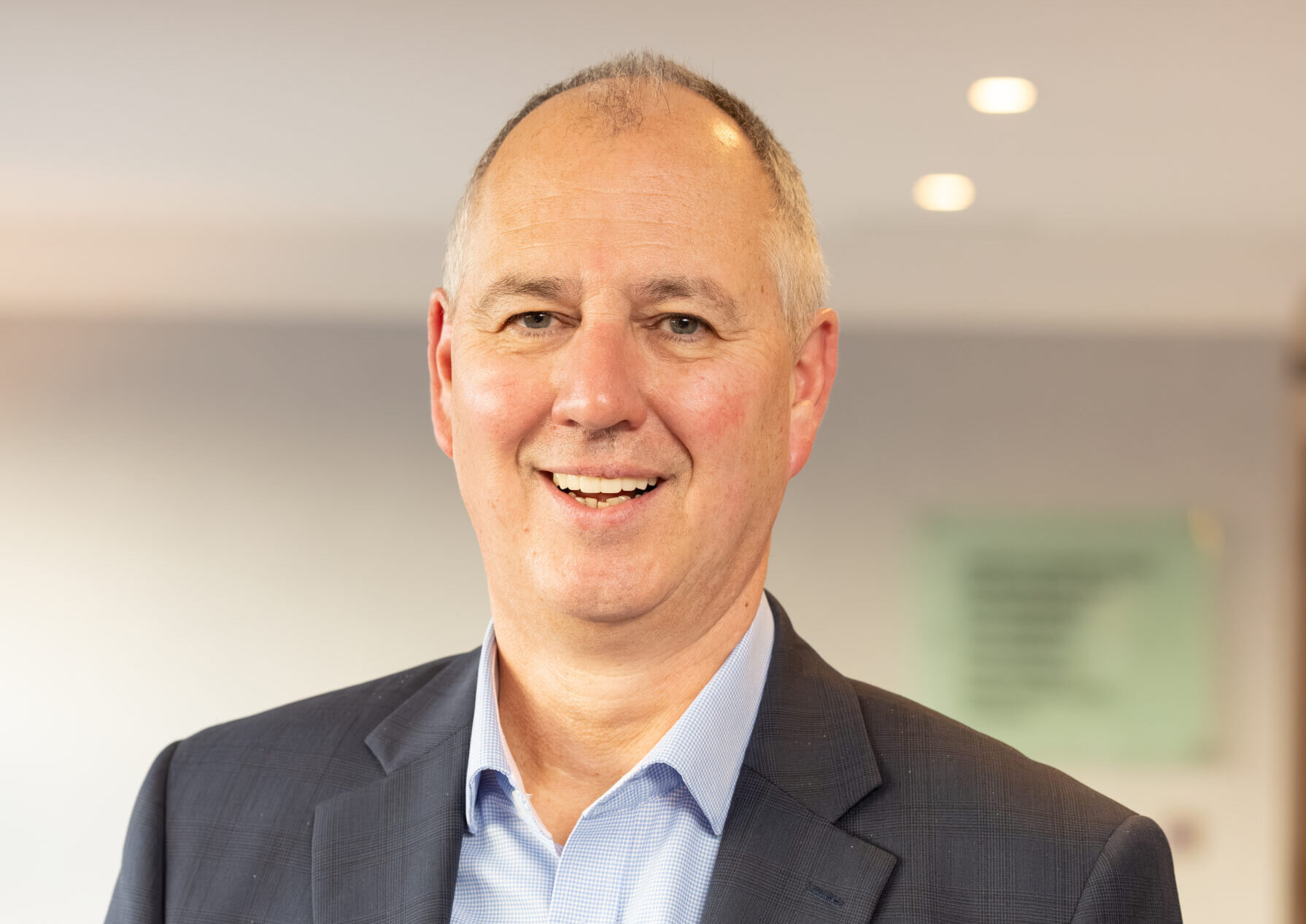
Rob Shearing, chief executive of the Road Safety Markings Association (RSMA), talks to Dominic Browne from Highways Magazine about taking on challenges and unlocking potential. You can read the full interview below.
Mr Shearing arrived in the sector about three years ago from a background in finance. By his own admission, he knew absolutely nothing about road markings. Yet in that short time, he has overseen new industry guidance, accelerated the RSMA’s professionalisation and training provision, played a celebrated role in the infrastructure competence agenda, joined industry steering groups, overseen national marking surveys, tackled the skills crisis head-on and helped forge such a close working relationship with National Highways that maybe, just maybe, the road marking sector might get a live trial of new products after decades of waiting.
So how has this mild-mannered, deeply sympathetic man (with a laugh as free as a river in full spate) managed to become one of the key figures in the industry in such a short amount of time? Well, when asked what people need to know about him, he gives a good answer to both questions: ‘I will always listen and I care. When people say to me that there’s a problem, I will do my utmost to get it sorted.’
In fact, whatever the question, he reveals the same humanity. At the core of Mr Shearing is a desire to see everyone fulfil their potential.
‘Being a chief executive is one of the greatest roles you can have. I love a challenge. I think it’s that ability to make a difference and leave some form of legacy behind that is really important,’ he says.
One of the things he loves about the markings sector is ‘how collaboratively they work together’: ‘I’ve heard stories of someone’s truck breaking down when they needed to get a job done, and what would be perceived as a competitor has arrived to help them so that job can be completed. That collaboration runs right through our organisation. This sector has it like no other. It was an eye opener, but a positive one. And one that we should champion because that happens a lot.’
It feels in keeping that one of his first actions in charge was to expand the RSMA’s training provision: ‘When I arrived, we had one full-time trainer, so building more capacity into the team was one of the first things we did and we’re still working on that to be fair. We have a great facility in Gainsborough, but we probably don’t utalise it as much as we could. Now when a member rings us and says, we’ve got three people who need to go on a specialist applied skills programme (SAP) we can do it quickly. We can be more proactive in how we reach out to our members for their training needs and that breeds confidence.’
Tackling the skills crisis through boosting the diversity of the industry has always been a key theme in Mr Shearing’s leadership - one that has featured heavily in his annual conference programmes. This year’s event saw L&R Roadlines give a presentation on what is potentially the first, or at least one of the few, all-female markings crews. While the achievement belongs to L&R Roadlines, it seems a fitting milestone in Mr Shearing’s premiership.
One of the lessons learned from this female diversity agenda is the importance of small considerations that make a big difference including, and there is no getting away from this, toilets. ‘Anecdotally, we have been made aware by quite a lot of our members that they’ve been awarded big contracts on big networks and the client is not prepared to pay for welfare facilities. If we are going to make highways open to everybody, we must have welfare facilities for everybody. And actually, if that costs a little bit more then that’s the cost we have to bear. Bottom lines are important, but people within are important. And if we don’t have those people within our industry, then we are shooting ourselves in the foot somewhat.’
The issue is so important that the RSMA has even ‘discussed doing some sort of welfare guidance at some point in the future’. This follows the success of having produced new temporary traffic management guidance, unveiled at last year’s conference.
‘The guidance helps ensure people are doing things in a professional way, in a safe way, ensuring that everybody gets home, safe and well, and that road users are fully informed on their journey.’
It is particularly impressive as the guide looks at those ‘smaller works at junctions and rural locations, for instance, where traditionally people just rocked up, put up a stop and go board and then got out as quickly as possible, but not necessarily in a safe way’.
The temptation in these works was always for speed to be the priority. Thanks to the RSMA guidance and trials, the case has been made for a safer system that ‘literally only adds 15 minutes to set up and take down,’ putting to bed the lie that safer traffic management would take too long for such jobs.
All this is impressive enough, and it would be wrong to set the bar any higher, perhaps, but nonetheless Mr Shearing is on the brink of helping secure live trials for markings and studs on the national networks. The lack of trials has, for countless years, seen companies from the very nation that created the Cat’s Eye, go abroad to get new products tested. It became something of a white whale under the previous leadership. However, Mr Shearing has taken a more humble, practical approach. He confesses that the RSMA, with its small team and membership focus, is not really equipped to take on the legal and insurance juggernaut of live trials. Instead, he has shifted the focus to supporting National Highways.
‘I worked quite closely to put a case together so that National Highways can run their own trial. It needed to sit with National Highways in fairness. I’m pleased to say that they are now exploring the possibility and have gone quite a long way down the road. I know they have held a lot of meetings over the last few months around putting the case together to say there’s a real reason for this, and there’s a real reason why National Highways should lead it. We will support them 110% in doing that.’
A decision is imminent, but even without it, Mr Shearing is well on his way to securing his legendary status in markings. Compared to previous well-known RSMA leaders, he sets a quieter tone, but he has a lot to shout about.