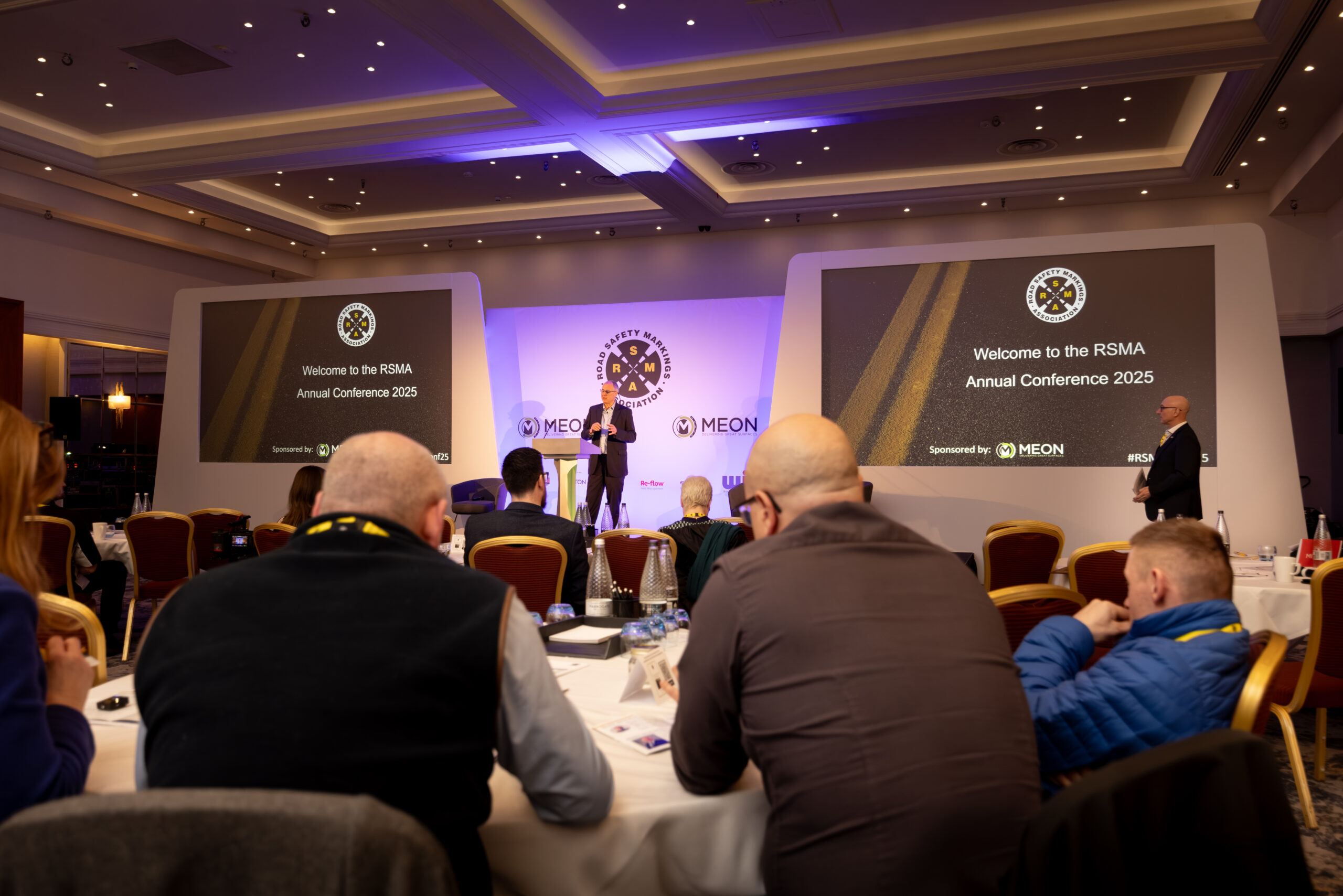
Deputy editor George Barker from Highways Magazine reports on the Road Safety Markings Association’s (RSMA) annual conference in February, which saw members celebrate a major milestone and speakers reflect on where the future might take us. You can read the full article below.
Founded in 1976, the RSMA is entering its 50th year. As National Highways’ director of engineering, Dr Jo White, noted in her opening address, this means the association dates back to Concorde’s first commercial supersonic flight, British Rail’s introduction of the Intercity 125 high speed train and the year when the Ford Escort Mark 2 was the highest-selling car in the UK. The difference being that the RSMA still has a vital role in UK transport, of course. Dr White makes a strong case for it remaining that way: ‘We’re entering an era of digital roads, where, in the future, we could see infrastructure communicating more with vehicles and vice versa. Road markings and road studs may also become part of this solution, perhaps embedded with something that can monitor traffic, or weather conditions. We may even see dynamic lane markings that shift in real-time to manage traffic flow.’
Indeed, Dr White stressed that markings have become even more crucial as cars have become ‘computers on wheels’ due to technology like lane assist being reliant on accurate and clear markings. ‘No matter how advanced our vehicles become, road markings and road studs will remain as a vital interface between human drivers, autonomous systems, and the road itself,’ she concluded.
Sadly, the most anticipated news of the day took a rain check. Highways understands that the RSMA’s UK-wide lining survey has been completed but the final results were not ready for release.
Innovation is not just needed for the road itself. Michael Littleboy, MD of L&R Roadlines, argued that current recruitment methods are struggling and need to adapt. Mr Littleboy urged the sector to approach two relatively novel recruitment pools for the highways industry, women and ex-offenders.
L&R looked at practical ways to encourage more women into road marking, including adapting certain roles or equipment, or ensuring that on-site facilities, such as locker rooms, catered to both men and women. The company also worked with an offender rehabilitation programme to secure staff, while also helping to reduce reoffending rates through employment.
Dr Suzy Charman, executive director of the Road Safety Foundation, had the bright idea of asking an artificial intelligence system to identify some of the most important road safety innovations of the decades; the implementation of seatbelt laws, the first 20mph speed limits and the first speed cameras were some of the leaps forward that it picked out. However, clearly AI isn’t ready to take over just yet, as it neglected to note the importance of road markings: ‘Your hard work and innovation should be on here. One of the more important life-saving measures we have, that’s cost effective, is raised profile markings. Every small improvement that you make to the legibility of the road will save lives,’ DR Charman said.
RSTA members were also given an update on National Highways’s ‘Home Safe and Well’ campaign from Mel Clarke, the road authority's director of health, safety and wellbeing, which was accompanied by a presentation from Andrew Cox, managing director for FM Conway. He discussed health and safety issues and his companies ‘fail safety’ strategy - essentially a Safe System approach to worker risk. Mr Cox argued the ambition should be to design systems that take account of the ever-present ‘human factor’ risk.
‘We have to get into engineering isolation and ideally elimination [of risk],’ Mr Cox said.
The afternoon saw two presentations: one from Emma McGrath, professional support solicitor at Citation, on changes to employment law, and the other from vice president of road marking systems at SWARCO, Harald Mosbock, about glass bead production in Europe. Then, Darren Capes, ITS policy lead for the Department for Transport (DfT0. completed the horizon-gazing theme, with two different visions of the future: ‘We could end up with a world where we, by accident, give up the power to manage the network. We could see manufacturers and others interpret the rules of the road in different ways and convey them in different ways. That is the dystopian future. The utopian future is that we work to understand the way technology is going, and we deliver decisions with the same power and clarity, but using new technology.’
Closing the conference, the RSMA CEO Rob Shearing described the 50th anniversary as ‘an incredible achievement, reflecting the passion, innovation and collaboration that underpin our sector’.
‘It was particularly important to see such strong, insightful presentations from key voices, sharing expertise and helping to shape the future.’